Every nation talks about sovereignty. Few define it.
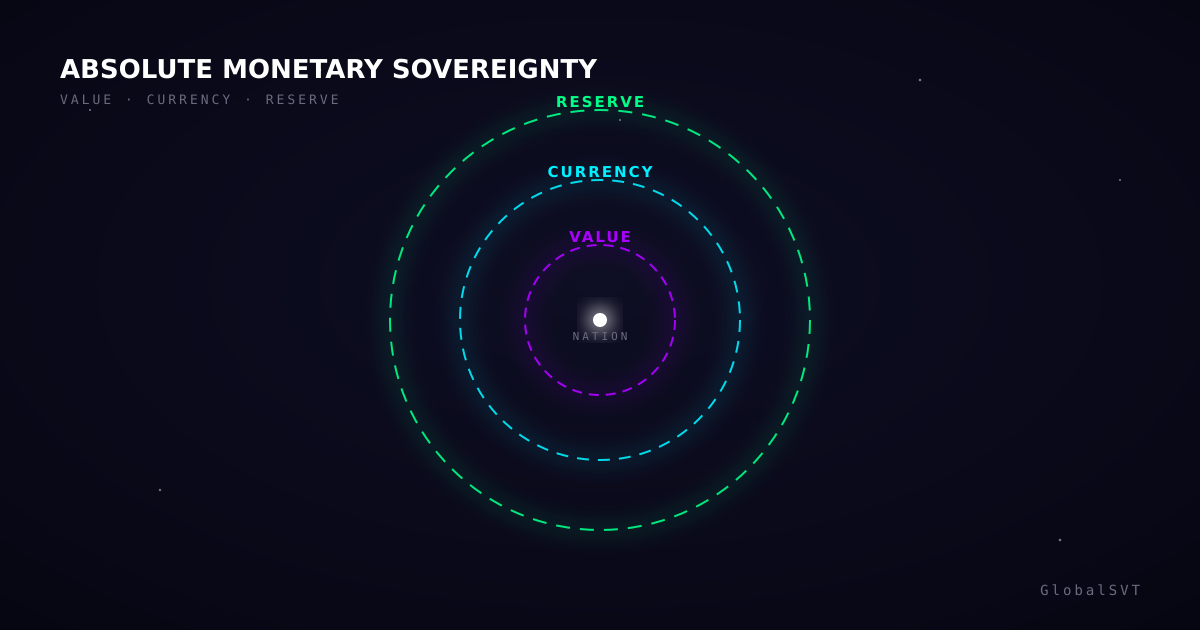
Absolute monetary sovereignty is not one thing. It is three things — value sovereignty, currency sovereignty, and reserve sovereignty.
No nation has ever achieved all three. That is now possible.
The three layers of monetary existence
A nation's monetary existence has three fundamental layers:
For a nation to be truly sovereign, all three must be sovereign.
Layer 1 — Value Sovereignty
Value sovereignty is the ability of a nation to recognize, verify, value, and mobilize its own economic value — without selling its assets, without encumbering them, without surrendering monetary sovereignty, and without depending on external permission.
Value sovereignty is missing because the infrastructure is missing. No discovery infrastructure. No registry infrastructure. No verification infrastructure. No valuation infrastructure. No channeling infrastructure.
The result: nations are asset-rich but liquidity-poor. They have wealth but cannot use it.
Layer 2 — Currency Sovereignty
Currency sovereignty is the ability of a nation to issue and manage its own currency — backed by its own sovereign value, not only by external reserves or debt.
Currency sovereignty is missing because the backing is missing. Nations issue currency against external reserves or debt, not against their own sovereign value.
The result: nations are constrained by external monetary conditions. Their monetary policy is partial. Their currency is not fully sovereign.
Layer 3 — Reserve Sovereignty
Reserve sovereignty is the ability of a nation to hold its reserve as its own sovereign value — rather than in external fiat.
Reserve sovereignty is missing because the holding infrastructure is missing. No standardized unit for holding sovereign value. No framework for reserve governance. No mechanism for reserve yield. No protocol for reserve depletion or impairment.
The result: nations hold reserves in someone else's currency. Their monetary sovereignty is partial. Their reserves are subject to foreign policy.
The old paradigm vs. the SVT paradigm
What absolute sovereignty means
Absolute sovereignty is achieved when all three are sovereign.
This has never existed. For China — and for every participating nation — it is now possible.
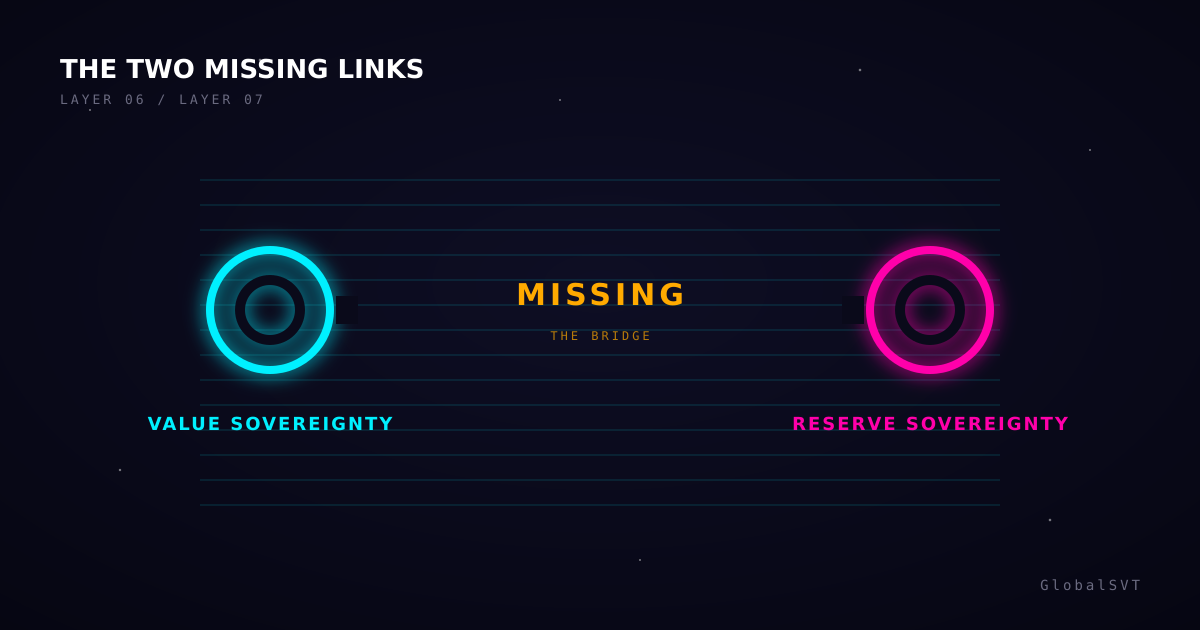
The two missing links
The two missing layers — value sovereignty and reserve sovereignty — are the missing links. They are Layers 06 and 07 in the 14-layer sovereignty architecture.
You can have value sovereignty without reserve sovereignty. You could mobilize your value but still hold your reserve in foreign fiat.
But you cannot have reserve sovereignty without value sovereignty. If you cannot mobilize your value, you have nothing to hold as reserve.
Value sovereignty is the prerequisite. Reserve sovereignty is the consequence.
The 14-layer stack
The two missing links are Layers 06 and 07 in a 14-layer sovereignty architecture:
01 Energy Sovereignty
02 Compute Sovereignty
03 Data Sovereignty
04 Registry Sovereignty
05 Asset Sovereignty
06 Value Sovereignty         ← First Missing Link
07 Reserve Sovereignty       ← Second Missing Link
08 Monetary Sovereignty
09 Settlement Sovereignty
10 Network Sovereignty
11 Economic Sovereignty
12 Federated Sovereignty
13 Intelligence Sovereignty
14 Civilizational Sovereignty
The civilizational progression
The 14 layers enable a progression from fragmented sovereignty to regenerative sovereignty:
Progression: F → C → I → R (FSC → CSC → ISC → RSC)
The mission
GlobalSVT's mission is to enable 120 nations to transition from FSC to CSC by 2040 — and toward ISC and RSC thereafter.