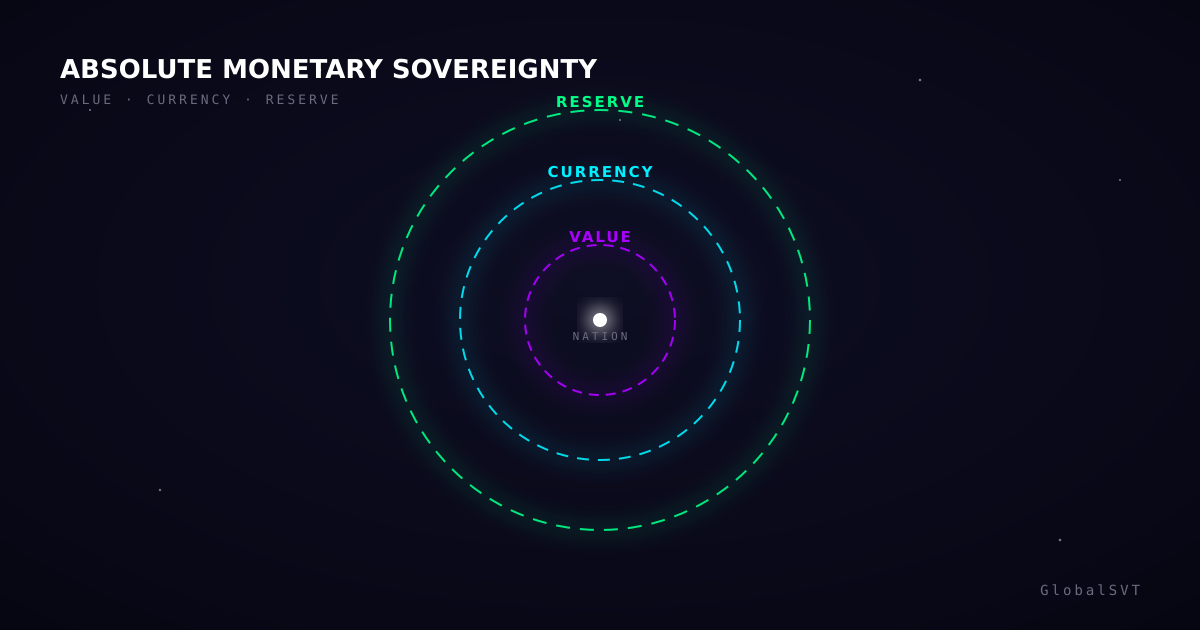
Every nation today has political sovereignty. Legal sovereignty. Territorial sovereignty. Even formal monetary sovereignty.
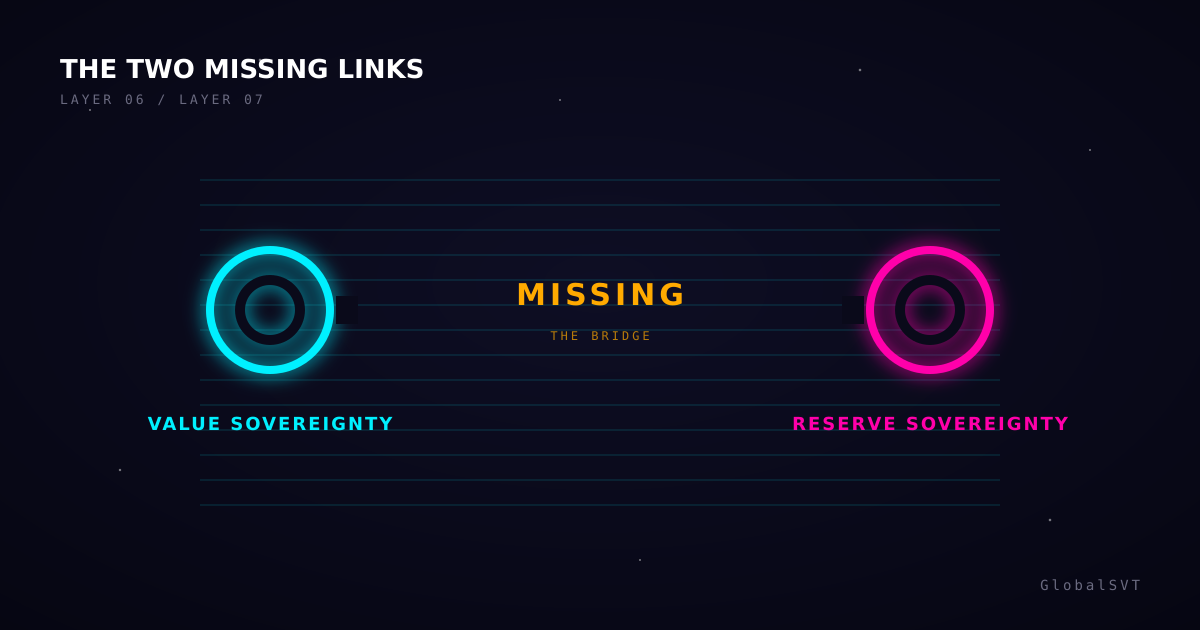
But no nation has value sovereignty or reserve sovereignty.
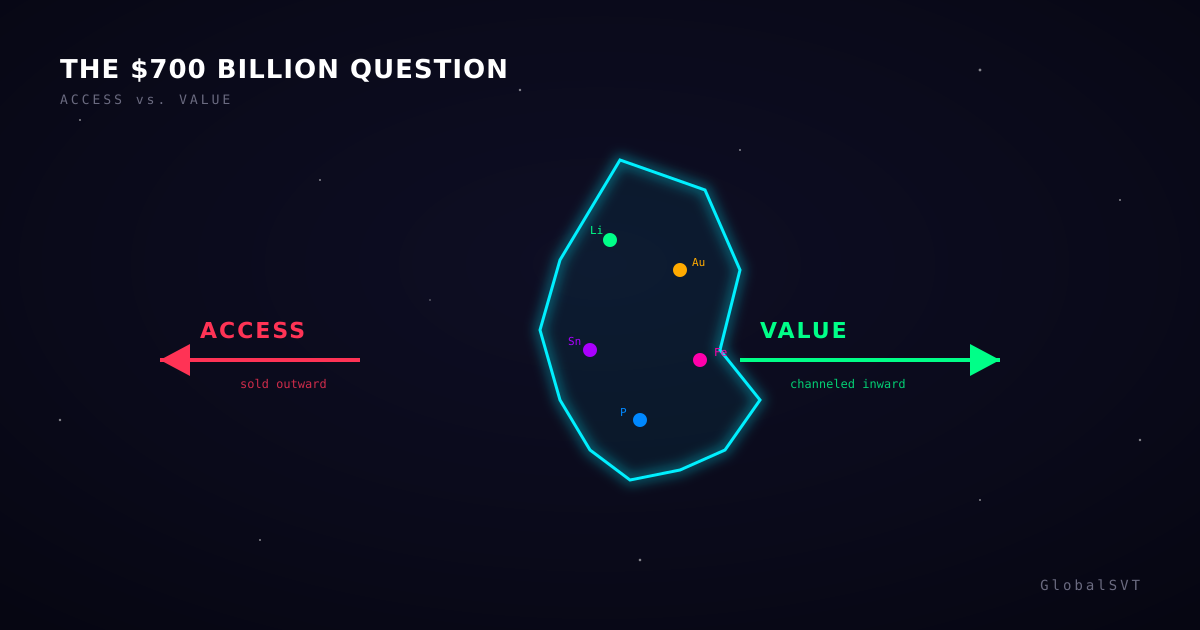
These are the two missing links. They explain why nations are asset-rich but liquidity-poor. Why they have wealth but not spendability. Why they must sell access to their assets, pledge them, or borrow externally.
Missing Link 1: Value Sovereignty
Value sovereignty is the ability of a nation to recognize, verify, value, and mobilize its own economic value — without selling its assets, without encumbering them, without surrendering monetary sovereignty, and without depending on external permission.
It does not exist because the infrastructure does not exist.
- No discovery infrastructure. Nations do not know what they own.
- No registry infrastructure. Nations cannot record what they own.
- No verification infrastructure. Nations cannot prove what they own.
- No valuation infrastructure. Nations cannot value what they own.
- No channeling infrastructure. Nations cannot mobilize what they own.
The result: nations are asset-rich but liquidity-poor. They must sell access, pledge assets, or borrow externally. They cannot fund their own development from their own value. They cannot establish reserve sovereignty.
Missing Link 2: Reserve Sovereignty
Reserve sovereignty is the ability of a nation to hold its reserve as its own sovereign value — rather than in external fiat.
Even if a nation could mobilize its value, there is no infrastructure to hold that value as reserve.
- No holding infrastructure. There is no standardized unit for holding sovereign value.
- No governance infrastructure. There is no framework for reserve governance.
- No yield infrastructure. There is no mechanism for reserve yield.
- No depletion infrastructure. There is no protocol for reserve depletion or impairment.
The result: nations hold reserves in someone else's currency. Their monetary sovereignty is partial. Their reserves are subject to foreign policy.
Why these are two, not one
You can have value sovereignty without reserve sovereignty. You could mobilize your value but still hold your reserve in foreign fiat.
But you cannot have reserve sovereignty without value sovereignty. If you cannot mobilize your value, you have nothing to hold as reserve.
Value sovereignty is the prerequisite. Reserve sovereignty is the consequence.
The chain of causation
- Missing Link 1: No value sovereignty. Nations cannot recognize, verify, value, or mobilize their own value.
- Missing Link 2: No reserve sovereignty. Nations must hold reserves in external fiat.
- Nations are asset-rich but liquidity-poor.
- Nations must sell access to their assets.
- Sovereignty is formal, not real.
What the infrastructure looks like
GlobalSVT builds the infrastructure that closes both missing links.
- SVSA — Sovereign Value Spendability Architecture builds value sovereignty. It provides the infrastructure for discovery, registry, verification, valuation, and channeling.
- The Reserve Pool builds reserve sovereignty. It provides the infrastructure for holding, governance, yield, and depletion protocols.
Together, they enable absolute sovereignty.
What changes when both links exist
When a nation has value sovereignty and reserve sovereignty:
- It can fund its own development from its own value. No external debt. No policy conditions.
- It can hold its own value as reserve. No foreign fiat. No foreign policy risk.
- It can settle directly with any other nation. No USD intermediary. No multi-day delays.
- It can achieve absolute sovereignty — value, currency, and reserve all sovereign.
The reserve currency paradigm ends — not by defeat, but by obsolescence.
Spendability — where the two links pay off
The whole point of closing these two links is spendability — the ability to actually use your own value.
Take new issuance. Today, when a nation needs money it prints debt or borrows in someone else's currency. With value sovereignty and reserve sovereignty in place, a central bank can mint new sovereign currency directly against verified national value in the reserve — not against debt, not against dollars, not against an asset it has pledged to a foreign party. The new money is spendable the moment it is minted, because it is already backed by something the nation independently owns and independently verified. No external approval. No intermediary. No waiting.
The same logic unlocks cross-border settlement. When two sovereigns each hold their own value as reserve, they no longer need a dollar correspondent bank standing between them. Nation A extinguishes its own sovereign unit and Nation B mints the equivalent of its own, atomically, peer to peer. Direct sovereign-to-sovereign. No USD leg. No multi-day clearance. No foreign-policy veto. Settlement that used to take days through three or four banks now takes seconds between two central banks — and it is final and irrevocable.
That is the practical difference the two missing links make: domestic spendability through new issuance against verified value, and global spendability through direct sovereign-to-sovereign settlement. Value that a nation owns but cannot spend is not sovereignty. Value it can spend — at home and across borders — is.
The 14-layer stack
The two missing links are Layers 06 and 07 in a 14-layer sovereignty architecture:
01 Energy Sovereignty
02 Compute Sovereignty
03 Data Sovereignty
04 Registry Sovereignty
05 Asset Sovereignty
06 Value Sovereignty         ← First Missing Link
07 Reserve Sovereignty       ← Second Missing Link
08 Monetary Sovereignty
09 Settlement Sovereignty
10 Network Sovereignty
11 Economic Sovereignty
12 Federated Sovereignty
13 Intelligence Sovereignty
14 Civilizational Sovereignty
Layers 06 and 07 are the bridge between assets and money. Without them, nothing above Layer 05 can function.
What this means for every nation
Every nation possesses enormous value. Land. Minerals. Energy. Infrastructure. Productive capacity. Data. Compute. Human capital.
But possessing value is not the same as being able to use it.
A nation may possess $X trillion of underlying sovereign and productive value while simultaneously experiencing infrastructure deficits, insufficient power, weak industrial capacity, financing constraints, and high external borrowing costs.
The fundamental problem is: how does a nation convert the value of what it already possesses into the infrastructure and productive capacity required to become more developed, resilient, and sovereign?
The answer is value sovereignty and reserve sovereignty.
The infrastructure is GlobalSVT.
The question is whether nations will build it — or continue selling access to their value to those who will.