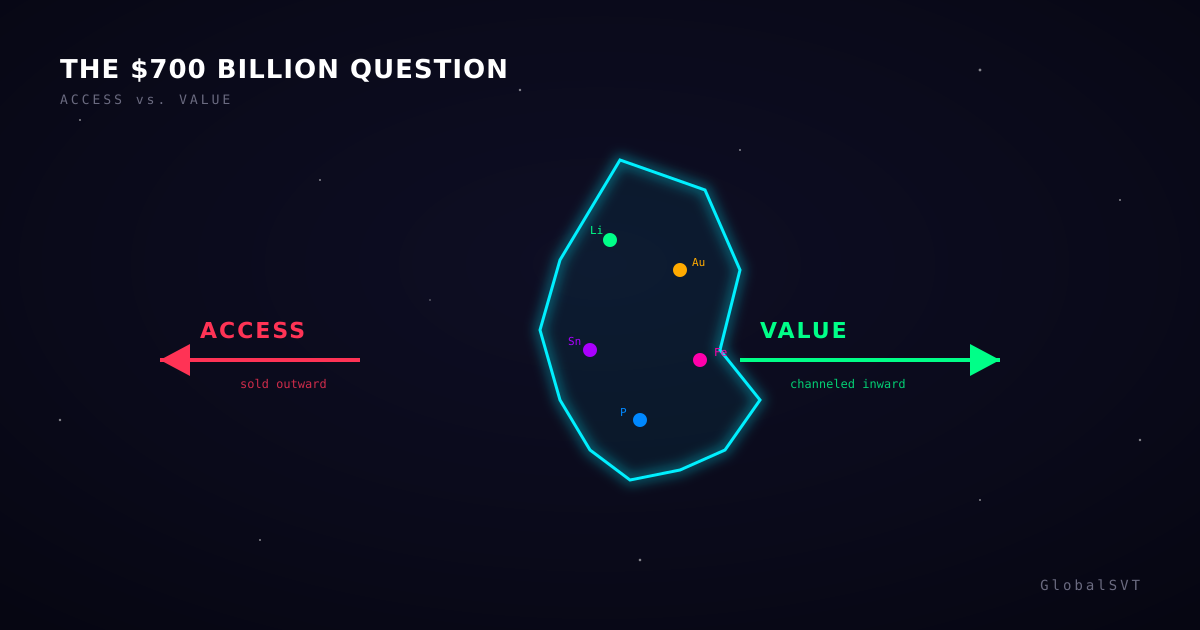
On September 24, 2026, Nigeria and the United States signed a framework agreement covering $700 billion in mineral resources — lithium, gold, tin, iron ore, and phosphate.
The agreement is explicitly positioned as a counter to China's growing role in Africa's critical minerals supply chain.
China has already invested $1.3 billion in Nigerian lithium processing and is negotiating a further $5.7 billion with Chinese firms. China built the lithium processing plants. China is negotiating the power and mining package.
But the US just opened a $700 billion door. China is ahead — but the window is closing.
That deal is a symptom. The deeper cause is this: Nigeria is selling access to its minerals because it cannot mobilize its own value.
Nigeria is asset-rich but liquidity-poor. It has minerals but no spendability. It has wealth but no way to use it.
Like almost every nation, Nigeria's reserves are held in external fiat — predominantly USD, in foreign jurisdictions, subject to foreign policy. Sovereignty is formal, not real.
This is not a Nigerian problem alone. It is every nation's problem.
What Nigeria actually sold
When Nigeria signs a $700 billion framework agreement, what is actually being exchanged?
Not the minerals themselves. Nigeria retains ownership of the ground.
What is being exchanged is access — the right to extract, process, and export. The right to determine the price. The right to capture the value chain.
Nigeria is not selling its minerals. Nigeria is selling its spendability.
Because Nigeria cannot mobilize the value of its own minerals, it must invite someone else to do it. And whoever does it captures the value.
This is the fundamental problem. And it is not solved by negotiating a better deal. It is solved by building the infrastructure that makes the deal unnecessary.
The two missing links
Why can Nigeria not mobilize its own value?
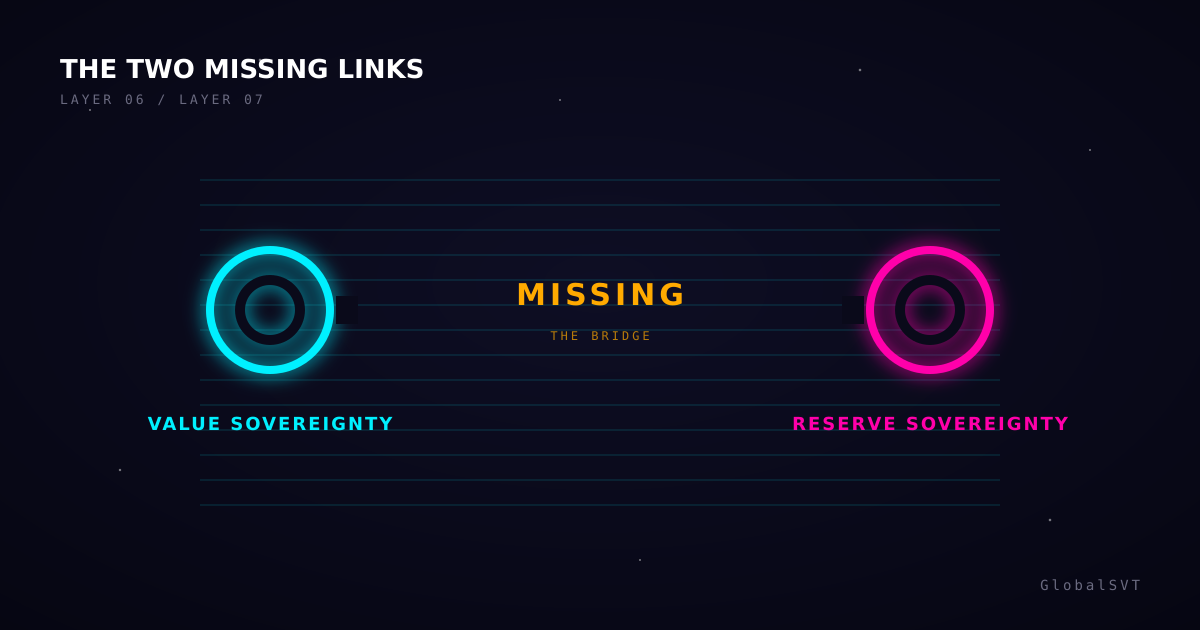
Because there are two layers of sovereignty that have never been built:
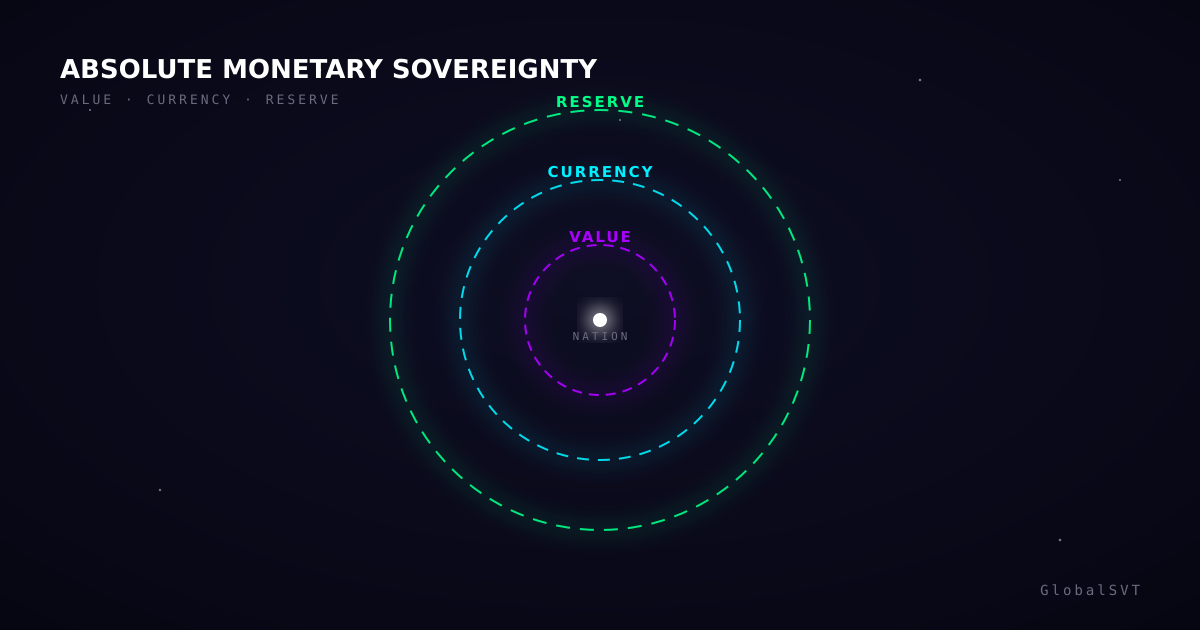
- Value sovereignty — the ability to recognize, verify, value, and mobilize national economic value without selling assets, without encumbering them, without external permission.
- Reserve sovereignty — the ability to hold national reserve as sovereign value rather than in external fiat.
No infrastructure exists to discover, register, verify, value, and channel sovereign value into circulation. No infrastructure exists to hold that value as reserve.
So nations do what Nigeria is doing. They sell access. They pledge assets. They borrow externally. They accept policy conditions. They lose sovereignty.
What the $700 billion deal could have been
Imagine the same $700 billion in mineral resources, but with value sovereignty and reserve sovereignty in place.
Nigeria registers the assets. Independently verifies ownership and existence. Independently values them. Determines the eligible portion. Channels that value into spendable capacity.
That value backs new issuance of sovereign currency — not debt, not external borrowing, but direct minting against verified sovereign value.
Nigeria uses that capacity to pay for development. To build power plants. To build refineries. To build the industrial capacity that processes its own minerals.
Nigeria does not sell access. Nigeria does not pledge assets. Nigeria does not borrow externally. Nigeria does not accept policy conditions.
Nigeria uses its own value to build its own future.
The difference
The difference between the $700 billion deal and the $700 billion opportunity is not the minerals. It is the infrastructure.
With value sovereignty and reserve sovereignty, Nigeria would not need to sell access. It would not need to invite someone else to capture its value. It would not need to choose between the US and China.
It would have its own path.
That is what GlobalSVT builds. That is the infrastructure that makes sovereign value spendable. That is the path from asset-rich but liquidity-poor to sovereign.
What happens next
The $700 billion deal is not the end. It is the beginning of a pattern that will repeat across Africa, Asia, and Latin America unless the infrastructure is built.
Every nation that cannot mobilize its own value will sell access to someone who can.
The question is not whether the value will be mobilized. The question is who will mobilize it — and who will capture it.
GlobalSVT is building the infrastructure that lets nations mobilize their own value. Not sell it. Not pledge it. Not borrow against it. Mobilize it.
That is the difference between a $700 billion deal and a $700 billion future.