The current global monetary system is built on the assumption that one currency must serve as the world's reserve.
This assumption has shaped global finance for eight decades. It has determined which nations can borrow cheaply, which nations must borrow expensively, which nations can run deficits, and which nations must run surpluses.
But the assumption is no longer necessary.
The end of the reserve currency era
The reserve currency era is ending — not by defeat, but by obsolescence.
The USD reserve system has three structural flaws that no amount of reform can fix.
Flaw 1 — The Triffin Dilemma. The reserve currency issuer must supply enough currency to lubricate global trade (which requires running deficits) while maintaining confidence in the currency's value (which requires not running deficits). These two requirements are in permanent conflict. The system works until it doesn't.
Flaw 2 — The Exorbitant Privilege and Its Resentments. The reserve currency issuer enjoys unique privileges: borrowing cheaply, running deficits, imposing sanctions through the currency. But every privilege generates a resentment. Every nation that holds USD reserves knows its reserve is subject to foreign policy.
Flaw 3 — The Single Point of Failure. When one currency is the global reserve, its monetary policy becomes global monetary policy. Its domestic politics become global politics. Its crises become global crises.
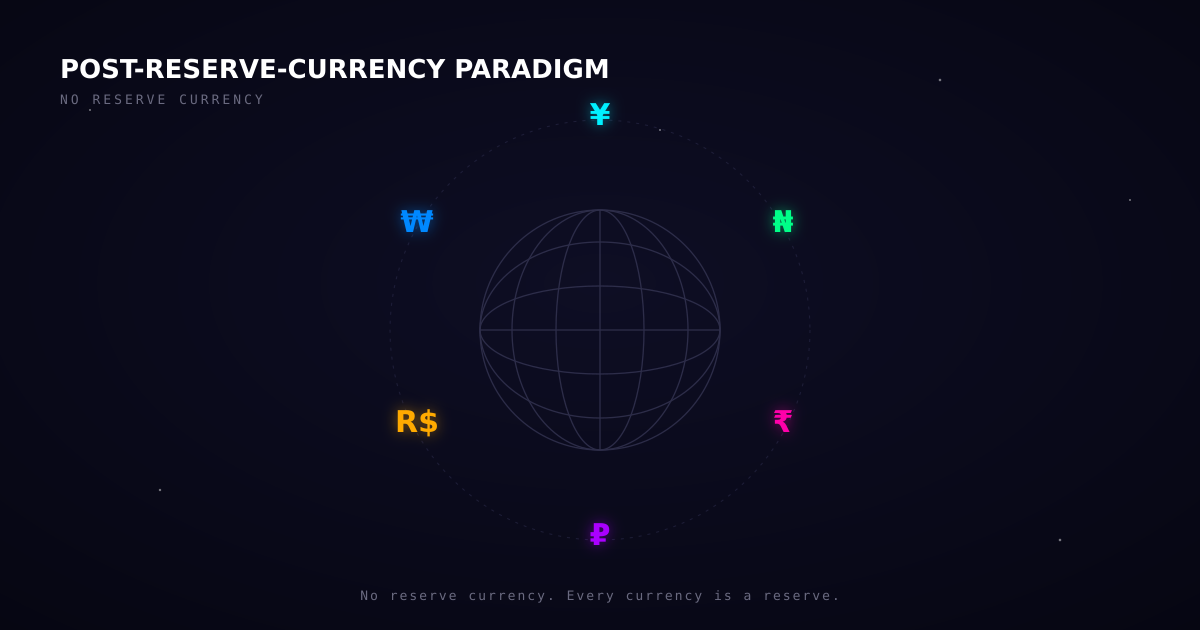
What the post-reserve-currency paradigm looks like
The post-reserve-currency paradigm is not about replacing USD with RMB. It is about ending the reserve currency paradigm entirely.
What changes when nations can hold their own reserve
The lifecycle comparison
Current System:
Nation produces → sells for USD → holds USD reserves → borrows USD for development
    ↓
Structural dependency → external policy conditions → lost sovereignty
GlobalSVT System:
Nation produces → settles via swap-minting → holds own sovereign value as reserve
    ↓
Direct minting for budget → development funded from own value → absolute sovereignty
Reserve sovereignty is not "hold RMB instead of USD"
Reserve sovereignty is not "hold RMB instead of USD." Reserve sovereignty is "hold your own sovereign value — and be able to spend it directly with any other nation."
This is the key distinction. The post-reserve-currency paradigm is not about replacing one reserve currency with another. It is about ending the need for a reserve currency entirely.
The three-layer architecture
The post-reserve-currency paradigm requires three layers:
Every currency is a reserve. Every reserve is sovereign. Every settlement is direct.